We thought we did everything right. We got three quotes. We checked online reviews. We asked for references. And we still managed to walk straight into a quote disaster that cost us an extra $2,000 and weeks of delays.
This is the story of our first major renovation quote — a full kitchen cabinet refacing + new countertops — and everything we misunderstood. I'm sharing it so you don't make the same mistakes.
The project (seemed simple)
Scope: Reface dated oak cabinets (new doors, drawer fronts, veneer on frames). Add quartz countertops. Keep existing layout.
House: Suburban townhouse, small kitchen, no major structural work.
Budget target: $6,000–7,000 (based on online research and initial calls).
We chose a mid‑priced contractor with good reviews. Their quote came in at $7,200. Not the cheapest, not the most expensive. Seemed reasonable.
We signed. And then the disaster unfolded.
What we misunderstood
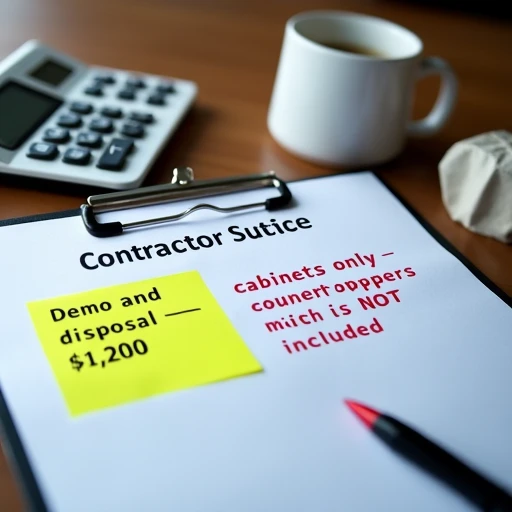
1. The quote didn't include removing the old countertops.
It said "demo and disposal" in the line item. We assumed that meant everything. It meant cabinet demo only. Countertop removal was an extra $400 because they had to call in a separate crew to disconnect plumbing and haul away the old granite.
2. "Cabinet refacing" didn't include new hinges or soft‑close mechanisms.
We assumed new doors came with new hinges. They didn't. The quote only covered the door fronts and veneer. Hinges were an upgrade (+$350). Soft‑close add‑ons? Another +$250. We kept the old, creaky hinges to save money — and now we regret it every day.
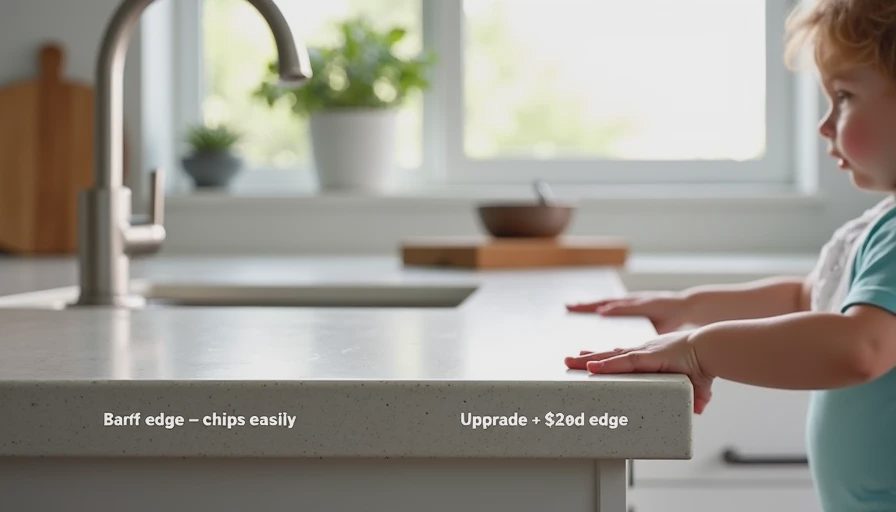
3. The countertop quote assumed a standard edge profile.
We wanted a simple eased edge (literally the most basic). The quote didn't specify edge profile. When we asked for it in writing, they said "basic edge included" — but their "basic" was a sharp square edge that chips easily. Upgrading to eased edge (+$200) or rounded (+$350) was extra.
4. "Installation includes plumbing disconnect/reconnect" — but not if plumbing moves.
We didn't move any plumbing. But the old sink had a different shape than the new one, so the existing supply lines were 2 inches too short. That was "unforeseen" and cost an extra $180 for longer braided lines and a plumber's trip.
5. The timeline was "2–3 weeks from signed contract."
We thought that meant 2–3 weeks from signing. It meant 2–3 weeks after they measured, after they ordered materials, after they scheduled the crew. Actual time from signing to completion: 7 weeks. No one told us the lead time for quartz fabrication was 4 weeks alone.
What we paid for anyway (because we felt trapped)
We were already in too deep. The old countertops were gone, the kitchen was torn apart, and we had a toddler eating takeout on a folding table. So we paid:
Extra countertop removal: $400
New hinges (basic, not soft‑close): $350
Eased edge upgrade: $200
Longer supply lines + plumber: $180
Total over original quote: $1,130
Plus the emotional cost of 7 weeks without a functional kitchen.
We did not pay for soft‑close, and we still regret it. We also didn't fight the timeline because the contract had no penalty for delays.
What we'd ask next time (a checklist for you)
If we could go back, here's every single question we'd ask before signing:
Before you even get a quote
Does your quote include a site visit and actual measurements, or is it a ballpark?
(Ballpark quotes are worthless. Pay for a measured quote.)Can you provide a written scope of work with every single line item?
(If they won't put it in writing, walk away.)
About demo
What exactly is included in "demo"?
Old countertops?
Old backsplash?
Disposal fees?
Disconnecting/reconnecting appliances?
Who is responsible for disconnecting and reconnecting plumbing, gas, or electrical?
(Get the specific trade names and license numbers.)What happens if demo reveals damage (rot, mold, unlevel subfloor)?
(Get the hourly rate or fixed price for unforeseen work in writing.)
About materials
What is included in the material line?
Hinges? Handles? Soft‑close mechanisms?
Edge profiles on countertops?
Backsplash? Underlayment? Sealant?
What brands and specific products will be used?
(Don't accept "premium quartz" — get the brand and line name.)Who orders materials, and who is responsible for delays?
(If the fabricator is 4 weeks out, that should be in the timeline.)
About timeline
What is the estimated start date, not just "after signed contract"?
What is the estimated completion date, broken down by phase?
Is there a penalty if the project runs more than X days over?
(Most won't agree to this, but at least ask. Their reaction tells you a lot.)
About payments
What is the deposit schedule? (Never pay more than 10–20% upfront in most states.)
Are progress payments tied to milestones? (e.g., after demo, after cabinets, after counters)
Is the final payment due only after final inspection and your sign‑off?
About the crew
Will the same crew work every day, or will subs rotate?
Who is the on‑site supervisor, and how do we reach them daily?
What are the daily working hours and cleanup expectations?
About the invisible stuff
Will you protect our floors, HVAC vents, and child's room from dust?
Do you carry liability insurance and worker's comp? Can you send a certificate?
What is your warranty period and what does it cover (labor, parts, both)?
The one thing we'd do differently (above all else)
Pay a small fee (like $200–300) to have an independent estimator or a trusted GC review the quote before signing.
We thought we could read a quote. We couldn't. A professional would have spotted the missing hinge line item, the ambiguous edge profile, and the countertop removal gap in five minutes.
That $300 would have saved us $1,100 and seven weeks of stress.
What we learned (the hard way)
A quote is not a contract. A detailed scope of work is a contract.
If it's not written down, it doesn't exist.
Never assume anything. "Standard" and "basic" mean different things to different people.
The lowest quote is rarely the best. The highest quote is rarely the worst. The most detailed quote is usually the one to trust.
Have you had a quote disaster? What did you misunderstand? Let's build a master list of "questions to ask before signing" — add yours in the comments.
No comments yet — be the first to share a thought.